Strawberry NFC Juice
Single-strength strawberry juice with recognizable ripe-fruit aroma, natural red color and sweet-tart berry character for beverages, dairy, fermentation, frozen desserts, bakery and foodservice applications.
Fresh strawberry character at natural single strength.
Commercial garden strawberry (Fragaria × ananassa) is known for its bright red color, characteristic aroma and balanced natural sweetness and acidity. Botanically, the strawberry is an aggregate accessory fruit: the fleshy red portion is the enlarged receptacle, while the small structures commonly called seeds on the outside are individual achenes.
NFC strawberry juice is produced by pressing or extracting sound, ripe strawberries and supplying the juice without the normal concentration-and-reconstitution step. It can be offered as clarified juice for cleaner visual applications or as cloudy juice retaining more fine suspended fruit material.
- Botanical crop: Fragaria × ananassa
- Bright red to deep red characteristic appearance
- Sweet-tart berry profile with highly recognizable aroma
- Commercial NFC commonly around 6–10 °Brix
- Clarified and cloudy juice styles are available
- Conventional and certified organic programs may be available
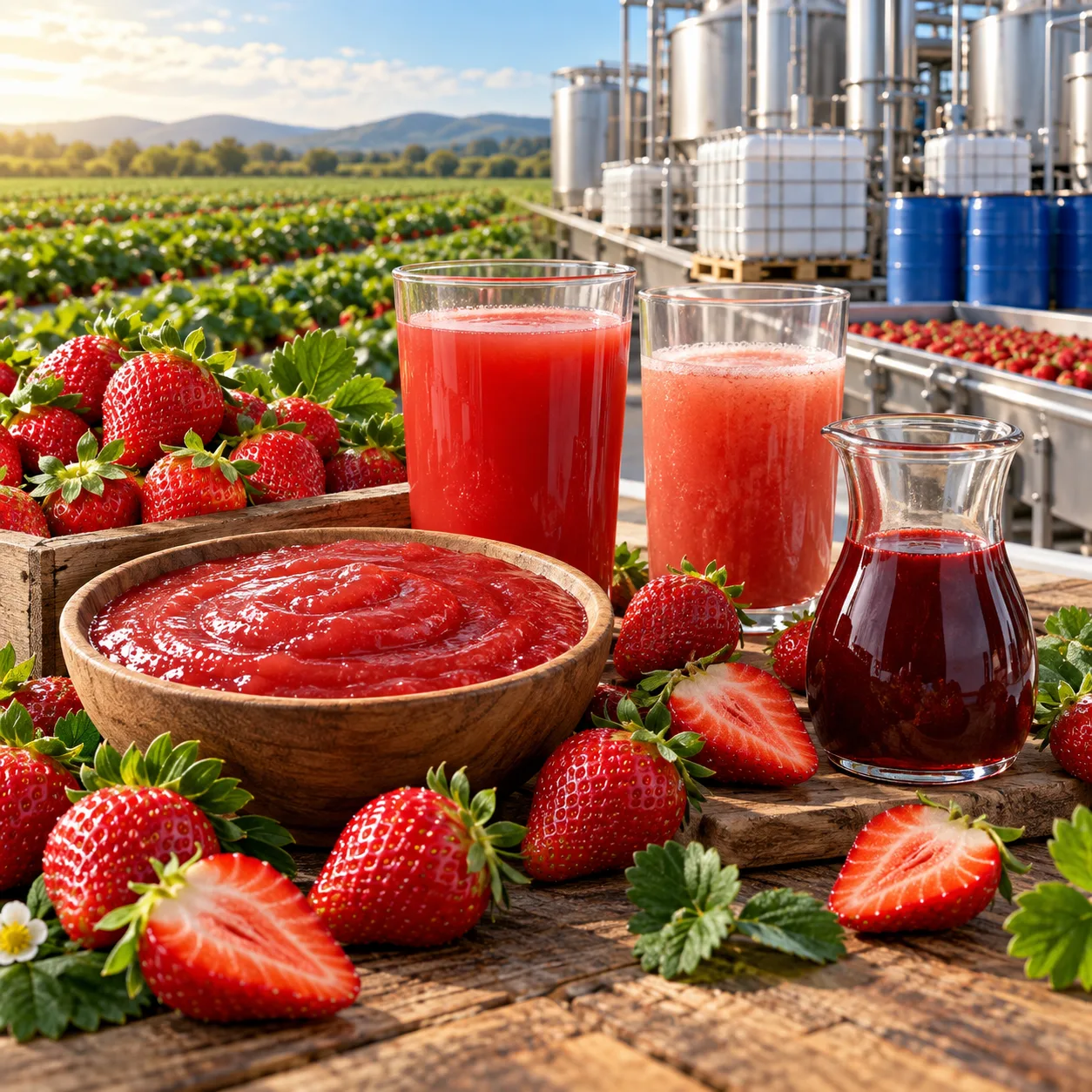
Ripeness and cultivar have a major effect on strawberry juice quality.
Flavor & Aroma
Ripe strawberries develop a complex aroma from volatile compounds that create the familiar fresh, floral, fruity and slightly caramel-like strawberry profile.
These aroma compounds are relatively delicate, which is one reason NFC formats can be attractive where a direct-fruit sensory profile is more important than maximum freight efficiency.
Color & Ripeness
Mature processing fruit develops bright to deep red color as anthocyanin pigments accumulate. Underripe fruit can contribute weaker flavor and paler color, while overripe or poorly handled fruit can develop fermented or oxidized notes.
Cultivar, maturity, growing region and processing conditions all influence finished juice color.
Strawberry is especially sensitive to crop variation. Brix, acidity, color and aroma should be reviewed together rather than using soluble solids alone as the measure of quality.
Key parameters used in industrial strawberry NFC purchasing.
Commercial specifications normally control soluble solids, pH, titratable acidity, color, aroma, clarification or turbidity, microbiology and the absence of objectionable seed or stalk material.
Analytical & Sensory Parameters
- Direct soluble solids measured as °Brix
- pH and titratable acidity
- Acidity basis, commonly expressed as citric acid
- Clarified or cloudy juice specification
- Color intensity and browning tolerance
- Characteristic ripe-strawberry aroma and flavor
- Seed, stalk and coarse-particle limits
Published Commercial Examples
Current strawberry NFC specifications include products around 7–9 °Brix, pH 3.3–3.6 and approximately 0.7–1.0% acidity expressed as citric acid.
Other industrial NFC programs specify approximately 7–10 °Brix, acidity around 0.3–1.0% or 0.4–1.4%, with pH generally below 3.9.
These ranges are published commercial examples, not universal strawberry standards. The current supplier specification and lot-specific Certificate of Analysis should govern purchasing.
FDA uses 8.0 °Brix for strawberry juice.
U.S. Regulatory Reference
FDA uses 8.0 °Brix as the minimum single-strength reference for strawberry juice when calculating juice percentage in beverages produced from concentrate.
The reference provides a standardized basis for juice-content calculations.
Directly Expressed NFC
Directly expressed strawberry juice is considered 100% juice without requiring concentration and reconstitution.
Actual NFC lots can naturally fall above or below 8 °Brix because soluble solids vary with cultivar, maturity, crop and origin.
Select juice style around visual clarity, body and processing behavior.
Clarified Strawberry NFC
Clarified juice is typically treated to reduce pectin and remove suspended fruit material, seed fragments and insoluble solids. The result is a brighter, more transparent juice with lower sediment.
It is useful in clear beverages, alcoholic drinks, sparkling products, syrups and applications where visible fruit cloud is undesirable.
Cloudy Strawberry NFC
Cloudy NFC retains more fine suspended fruit material and natural turbidity, providing greater body and stronger direct-fruit appearance.
It is well suited to smoothies, functional drinks, dairy systems and fruit-forward beverages where natural cloud is acceptable.
Clarified and cloudy products can have similar Brix but different filtration, sedimentation and mouthfeel characteristics. State the required physical format clearly when requesting quotations.
Strawberry's premium sensory attributes are also its most sensitive.
Heat Exposure
Strong or prolonged heating can move strawberry flavor away from a fresh profile toward cooked or jammy notes.
Evaluate juice after the actual pasteurization or finished-product heat process rather than only in the incoming ingredient.
Oxygen
Oxygen exposure during pumping, blending and storage can reduce fresh aroma and accelerate red-color loss.
Low-oxygen handling can therefore be important in premium strawberry beverage systems.
Storage
Strawberry color can gradually fade or brown during storage. Temperature, oxygen, light exposure and formulation conditions influence the rate of change.
Supplier-specific storage instructions should be followed closely.
Where strawberry NFC juice is used commercially.
Juice Drinks & Fruit Blends
Strawberry NFC provides recognizable berry aroma, red color and natural juice solids in still beverages, juice drinks and multi-fruit formulations.
Apple, white grape, pear, raspberry, lemon, banana and tropical juices can be used to build different sweetness and acidity profiles.
Smoothies & Functional Beverages
Cloudy strawberry NFC is particularly suited to smoothies and fruit-forward functional drinks where natural color and body are desirable.
Strawberry's familiar flavor can also help balance botanical, protein or other functional ingredients.
Drinking Yogurt & Dairy
Strawberry is one of the most established flavor profiles in drinking yogurt, cultured dairy beverages and fruit preparations.
Juice acidity should be considered when it is added directly to milk proteins or heat-treated dairy systems.
Plant-Based Beverages
Strawberry NFC works in oat, almond, coconut and other plant-based beverages and yogurt alternatives.
Color and protein stability should be evaluated through the complete heat treatment and shelf life of the finished product.
Ice Cream & Frozen Desserts
Strawberry juice can provide fruit flavor and color in ice cream, frozen yogurt, sorbet, ice pops and frozen beverage systems.
NFC is especially useful where fresh fruit aroma is valued, while puree may be selected when additional fruit body is needed.
Beer, Cider & Hard Seltzer
Strawberry NFC can be incorporated into fruit beer, cider, hard seltzer and other fermented beverage systems.
Fermentation can reduce fresh strawberry aroma, making dosage and addition timing important product-development decisions.
Kombucha, Wine & Fermented Drinks
Applications include kombucha, fruit wine, mead and other fermentation programs requiring authentic strawberry juice.
Incoming Brix and acidity should be measured when setting fermentation targets and final sugar balance.
Cocktails & Mocktails
Strawberry NFC is suitable for cocktail mixers, mocktail bases, spritzes, frozen drinks and foodservice beverage programs.
It pairs naturally with lemon, lime, basil, mint, rhubarb, peach and other berry ingredients.
Bakery Fillings & Desserts
Strawberry juice can contribute natural flavor and color to bakery fillings, dessert sauces, mousses, glazes and cake systems.
Puree or fruit pieces may be combined with NFC when additional body or visible fruit identity is required.
Chocolate & Confectionery
Strawberry is widely paired with chocolate and can be used in confectionery centers, fruit chews, jellies, gummies and flavor bases.
Concentrated or puree formats may be more efficient where very high fruit solids are required, while NFC supports a lighter direct-juice profile.
Sauces & Fruit Preparations
Applications include dessert sauces, fruit preparations, syrups, compotes, dressings and selected sweet-savory sauces.
Strawberry acidity can pair with balsamic-style, herb or chili profiles in more culinary formulations.
Foodservice & Central Kitchens
Bulk NFC juice can support smoothies, cocktails, desserts, sauces and beverage programs without the labor and seasonal variability of processing fresh strawberries on site.
Smaller bag-in-box or pail formats can be useful where a full industrial drum exceeds normal production throughput.
Select the ingredient format around fruit solids and logistics.
Strawberry NFC Juice
NFC stays near natural single strength and is suitable where direct juice character and a not-from-concentrate format are important.
Strawberry Juice Concentrate
Juice concentrate has much of its natural water removed and commercial products are commonly supplied around 65 °Brix.
It offers substantially greater freight and storage efficiency than NFC.
Strawberry Puree
Puree retains substantially more fruit tissue and provides greater body and texture than pressed juice.
It is often preferred for smoothies, fruit preparations, dairy variegates and applications requiring visible fruit character.
Bulk formats support both development and industrial production.
Bag-in-Box
Strawberry NFC can be supplied in aseptic bag-in-box formats for lower-volume manufacturing, foodservice and development programs.
Exact pack weights vary by processor and origin.
Aseptic Drums
Current commercial strawberry NFC programs include approximately 200 kg aseptic bags inside industrial metal drums.
Both conventional and organic products can be available in this format.
Frozen & Larger Bulk
Frozen drums, totes and tanker-scale programs may also be available depending on processor, origin and annual volume.
Cold-chain capability should be confirmed before selecting a frozen program.
Storage and shelf life are supplier-specific. Commercial programs include chilled, frozen and aseptic options. Follow the exact specification for unopened storage, thawing and post-opening use; do not infer shelf life from package type alone.
Define clarity, Brix and sensory expectations before comparing offers.
Technical Requirements
- True directly expressed NFC juice
- Clarified or cloudy physical format
- Target Brix and acceptable crop variation
- pH and titratable acidity
- Color and browning acceptance criteria
- Fresh-aroma and sensory requirements
- Seed and coarse-particle limits
- Microbiological specification
Commercial Requirements
- Conventional or certified organic grade
- Preferred origin or crop program if required
- Trial quantity and annual-volume forecast
- Bag-in-box, drum or larger bulk preference
- Frozen, chilled or aseptic receiving capability
- Delivery destination in the United States
- Required shipment schedule
- Certification and documentation requirements
Strawberry quality is highly sensory. Two NFC products with similar Brix can differ noticeably in red color, aroma intensity, acidity, clarity and cooked flavor. Technical and sensory approval should therefore be considered together.
Documents commonly reviewed during supplier approval.
Technical Documentation
- Current product specification
- Lot-specific Certificate of Analysis
- Complete ingredient declaration
- Clarification or turbidity specification
- Microbiological acceptance limits
- Storage and shelf-life information
- Packaging and handling instructions
Certification & Supply Documents
- Organic certificate when applicable
- Food-safety certification information
- Baby-food documentation where required
- Kosher or Halal documentation when requested
- GMO status where required
- Country-of-origin and traceability information
- Commercial quotation and delivery terms
Explore formulation and sourcing considerations.
Drinking Yogurt
Drinking Yogurt with Juice Ingredients: Sourcing & Process Considerations
Juice IngredientsChocolate Fillings
Using Juice Ingredients in Chocolate Fillings: Formulation Guide
Juice IngredientsFruit Bars
Fruit Bars with Juice Ingredients: Sourcing & Process Considerations
Strawberry NFC juice sourcing questions
What is strawberry NFC juice?
NFC means not from concentrate. Strawberry NFC is directly expressed juice produced from ripe strawberries and supplied near natural single strength without first concentrating and then reconstituting the juice.
What is the typical Brix?
Published commercial products range from approximately 6–10 °Brix depending on crop, cultivar and processor. FDA uses 8.0 °Brix as the single-strength reference for strawberry juice.
What are typical pH and acidity values?
Published commercial strawberry NFC specifications commonly show pH around 3.3–3.9 and titratable acidity around 0.4–1.4%, commonly expressed as citric acid.
What is the difference between clarified and cloudy NFC?
Clarified juice has most suspended solids, pectin and seed fragments removed to produce a brighter liquid. Cloudy NFC retains more fine fruit solids and natural turbidity, providing greater body and direct-fruit character.
Why can strawberry NFC lose color during storage?
Strawberry's red pigments are sensitive to heat, oxygen, light and storage conditions. Processing intensity and the finished formulation can therefore influence color stability over time.
What is bulk strawberry NFC juice used for?
Major applications include juice drinks, smoothies, functional beverages, drinking yogurt, plant-based beverages, frozen desserts, beer, cider, kombucha, cocktails, bakery fillings, confectionery, fruit preparations, sauces and foodservice beverages.
How does NFC differ from strawberry concentrate?
NFC remains near natural single strength. Strawberry juice concentrate has substantial water removed and is commonly supplied around 65 °Brix, giving much greater freight and storage efficiency.
How does strawberry NFC differ from strawberry puree?
NFC is pressed juice and contains less insoluble fruit material. Puree retains substantially more of the strawberry flesh and therefore provides greater body, viscosity and texture.
Is organic strawberry NFC available?
Yes. Certified organic strawberry NFC is commercially available from selected processors. Request current certification covering the exact origin, crop and product being offered.
How is commercial strawberry NFC packaged?
Commercial formats include aseptic bag-in-box, aseptic or frozen drums and larger bulk systems. Current industrial programs include approximately 200 kg aseptic drums.