Cranberry Juice Concentrate
Cranberry juice concentrate for commercial food and beverage manufacturing, delivering intense tart berry flavor, deep red color and concentrated fruit solids in a versatile high-strength ingredient.
A distinctive North American berry known for intense tartness and red color.
The American cranberry (Vaccinium macrocarpon) is a low-growing, evergreen fruit crop native to North America and related to blueberries. Small berries develop from pale flowers and mature from green or pale fruit to a characteristic deep red color.
Cranberries are naturally tart because their sugar level is relatively low compared with their substantial organic acidity. The fruit also contains naturally occurring polyphenolic compounds that can contribute a dry or slightly astringent sensory character.
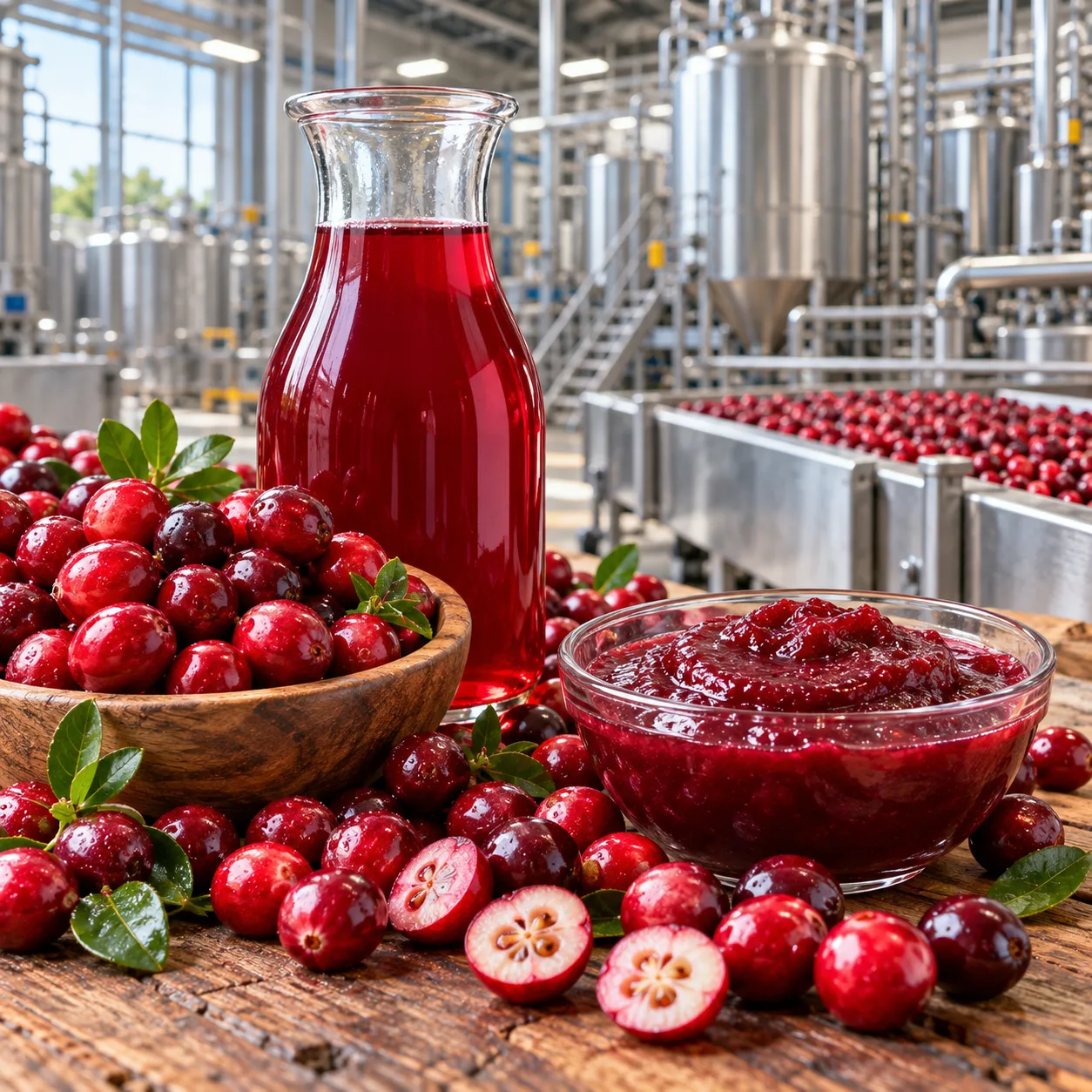
Commercial concentrate is produced by crushing or pressing ripe cranberries, separating juice from skins and seeds, filtering or clarifying as required and removing water under controlled evaporation. The resulting concentrate retains cranberry's characteristic red color and concentrated tart flavor.
- Bright tart flavor with characteristic cranberry astringency
- Deep red to dark ruby appearance
- Naturally high acidity compared with many fruit juices
- Clarified concentrate is common for industrial beverage use
- Conventional and certified-organic products may be available
- Frozen pail and lined-drum formats are widely used
Key parameters for commercial qualification.
Cranberry concentrate is naturally much more acidic than many common fruit concentrates. Commercial specifications therefore often distinguish between direct Brix and acid-corrected Brix and place particular emphasis on titratable acidity, color and turbidity.
Soluble Solids / °Brix
Commercial cranberry juice concentrate is commonly supplied around 50 °Brix with an approximate ±1 °Brix tolerance. Acid-corrected Brix can read several degrees higher because of cranberry's substantial acidity.
pH & Titratable Acidity
Representative 50 °Brix concentrates commonly fall around pH 1.9–3.2. Titratable acidity may be approximately 9–19% as citric acid at concentrate strength depending on crop and supplier specification.
Single-Strength Reference
Approximately 7.5 °Brix is commonly used as a commercial single-strength cranberry juice reference. Reconstitution should be based on the actual concentrate Brix and approved specification.
Color & Turbidity
Concentrate should retain the characteristic red cranberry appearance. Clarified grades may use turbidity targets such as less than approximately 25 NTU at single strength to maintain a clean beverage appearance.
Flavor & Sensory Profile
Flavor should be strongly tart and characteristic of cranberry, without fermented, scorched, caramelized or stale notes. Astringency is normal but intensity can vary by raw material and process.
Microbiological Criteria
Supplier specifications commonly establish maximum total plate count, yeast and mold levels. Representative commercial products may require total plate counts below approximately 1,000–2,000 CFU per milliliter.
These values are indicative commercial references only. Confirm direct and acid-corrected Brix, pH, titratable acidity, color, turbidity, microbiological limits and sensory requirements against the current supplier specification and lot-specific certificate of analysis.
Define concentration, clarity, certification and pack format.
Direct vs. Acid-Corrected Brix
Cranberry's high organic-acid content affects refractometer readings. Supplier documents may therefore list both direct Brix and a higher acid-corrected Brix. Buyers should confirm which value is used for purchasing and formulation calculations.
Clarified vs. Cloudier Grades
Clarified cranberry concentrate is useful in juices, sparkling drinks and other applications requiring lower suspended solids. Products with more natural haze may suit opaque beverages, sauces or preparations.
Packaging
Representative commercial programs include approximately 51 lb polyethylene pails and lined steel drums near 500 lb net weight. Exact pack sizes, liners and minimum quantities vary by supplier.
Storage & Shelf Life
Frozen storage around 0°F / -18°C is widely recommended. Representative supplier programs specify up to approximately three years of unopened frozen shelf life, while refrigerated holding after thawing is considerably shorter.
Documentation
Commercial approval may require a technical specification, certificate of analysis, nutritional information, allergen statement, country-of-origin declaration, microbiological results, traceability records and applicable organic or food-safety certifications.
Origin & Crop
Cranberry variety, growing region, harvest maturity and crop conditions influence acidity, color and flavor. North American production is especially important commercially, and consistency should be qualified against the actual processor and crop program.
Major uses for cranberry juice concentrate.
Juices & Beverage Blends
Cranberry concentrate is widely used in juice cocktails, mixed-fruit drinks, lemonades and premium beverage blends. Apple, grape and pear juice ingredients are often useful partners for balancing tartness.
Functional & Wellness Beverages
Cranberry's recognizable identity makes it useful in functional-style drinks, beverage shots and botanical blends where formulators want strong fruit flavor and deep red color without making medical claims.
Carbonated & Sparkling Drinks
The concentrate works well in sparkling fruit drinks, sodas, hard seltzer bases, spritz-style beverages and mixers because its acidity remains noticeable after dilution and carbonation.
Brewing, Cider & Fermentation
Cranberry concentrate can contribute fruit sugars, acidity and red color to hard cider, fruit beer, sour ale, mead, wine-style products and kombucha-type fermented beverages.
Dairy & Plant-Based Products
Applications include yogurt fruit preparations, cultured beverages and plant-based alternatives. Cranberry's substantial acidity requires careful control of protein stability and finished-product pH.
Sauces, Relishes & Glazes
Cranberry concentrate provides tartness and fruit character in cranberry sauces, glazes, chutneys, barbecue sauces and savory-sweet preparations for poultry, meat and plant-based foods.
Syrups & Fruit Preparations
High-strength concentrate can be incorporated into beverage syrups, dessert toppings, fruit preparations and foodservice bases where compact storage and concentrated flavor are commercially useful.
Confectionery & Gummies
Gummies, fruit chews, jellies and other confectionery products can use cranberry concentrate for authentic tart berry flavor and a naturally red fruit contribution.
Bakery & Snack Fillings
Applications include bakery fillings, bars, cookies and fruit-based snack systems where cranberry concentrate supports strong flavor without adding the water associated with single-strength juice.
Frozen Desserts
Cranberry concentrate can be used in sorbet, frozen yogurt, fruit bars and plant-based frozen desserts where its sharp acidity provides contrast to sweetness.
Balance strong acidity, color and natural astringency.
Reconstitution
Representative 50 °Brix concentrate can be diluted toward approximately 7.5 °Brix single strength. Actual water addition should be calculated from the incoming Brix and the finished-product standard.
Sugar-Acid Balance
Cranberry is substantially more acidic than many common fruit juices. Sweetener level, blending juice and final acidity should be developed together rather than setting sweetness from Brix alone.
Astringency & Flavor Balance
Natural cranberry polyphenols can contribute a dry or puckering sensation. Apple, grape, pear and other sweeter fruits can soften the profile, while higher cranberry inclusion produces a more intense finished flavor.
Color, Heat & Oxygen
Cranberry's red pigments can change during heating and storage. Finished color should be evaluated after the intended pasteurization, hot-fill, baking or other thermal process and under expected shelf-life conditions.
Build a complete cranberry concentrate inquiry.
Define the concentrate
Specify target Brix, pH or titratable acidity, color and turbidity, flavor profile and applicable microbiological requirements.
Select the supply format
Indicate conventional or organic status, preferred pail or drum format, frozen-storage requirements and any origin, certification or traceability restrictions.
Provide volume & destination
Include estimated shipment or annual volume, delivery destination, required timing and whether material is needed for samples, pilot trials or continuing commercial production.
Compare suppliers against the complete requirement.
Cranberries are agricultural raw materials and natural variation occurs between varieties, crops and origins. Technical specifications, certifications, packaging, storage requirements, availability and commercial terms should be confirmed against the current supplier specification and quotation.
See how juice concentrates perform in commercial formulations.
Marinades
Using Juice Concentrates in Marinades: Formulation Guide
Juice ConcentratesPlant-Based Yogurt
Plant-Based Yogurt with Juice Concentrates: Sourcing & Process Considerations
Juice ConcentratesFermentation Bases
Using Juice Concentrates in Fermentation Bases: Formulation Guide
Questions cranberry concentrate buyers often ask
What is bulk cranberry juice concentrate used for?
Commercial applications include juices and beverage blends, functional drinks, brewing and fermentation, dairy and plant-based products, sauces, syrups, fruit preparations, bakery fillings, confectionery and frozen desserts.
What Brix is typical for cranberry juice concentrate?
Commercial cranberry juice concentrate is commonly supplied around 50 degrees Brix, usually with a supplier tolerance around one degree. Other concentration levels may also be available.
What pH and acidity are typical for cranberry concentrate?
Representative commercial 50 degrees Brix cranberry concentrates commonly fall around pH 1.9 to 3.2, with titratable acidity often roughly 9 to 19 percent as citric acid at concentrate strength.
What is the typical single-strength reference for cranberry juice?
A common commercial reference is approximately 7.5 degrees Brix at single strength. Reconstitution ratios should be calculated from the actual incoming Brix and supplier specification.
Why is cranberry concentrate so tart?
Cranberries naturally combine relatively low sugar with substantial organic acidity and characteristic polyphenolic astringency. This gives cranberry concentrate its intense tart flavor and makes sweetness-acidity balance important in formulation.
Can cranberry juice concentrate crystallize during storage?
Yes. High-solids cranberry concentrate can develop natural sugar crystals during refrigerated or frozen storage. Controlled warming and agitation may be recommended by the supplier before use.
Is organic cranberry juice concentrate available?
Organic cranberry juice concentrate is commercially available from some suppliers. Buyers should request current organic certification and confirm the exact origin, processing program and product specification.
What information should I provide for a quote?
Provide target Brix, conventional or organic status, approximate quantity, required color or turbidity, packaging preference, destination, timing and any acidity, microbiological, certification or documentation requirements.